A Ceramic Found With Machine Learning Could Free Up Room Inside Wireless Devices
The phones, radios and satellites people rely on are packed with tiny capacitors, and a new ceramic could one day let them take less space. An international team used machine learning to find it, and one prototype part took about 85 percent less volume than a comparable commercial part.
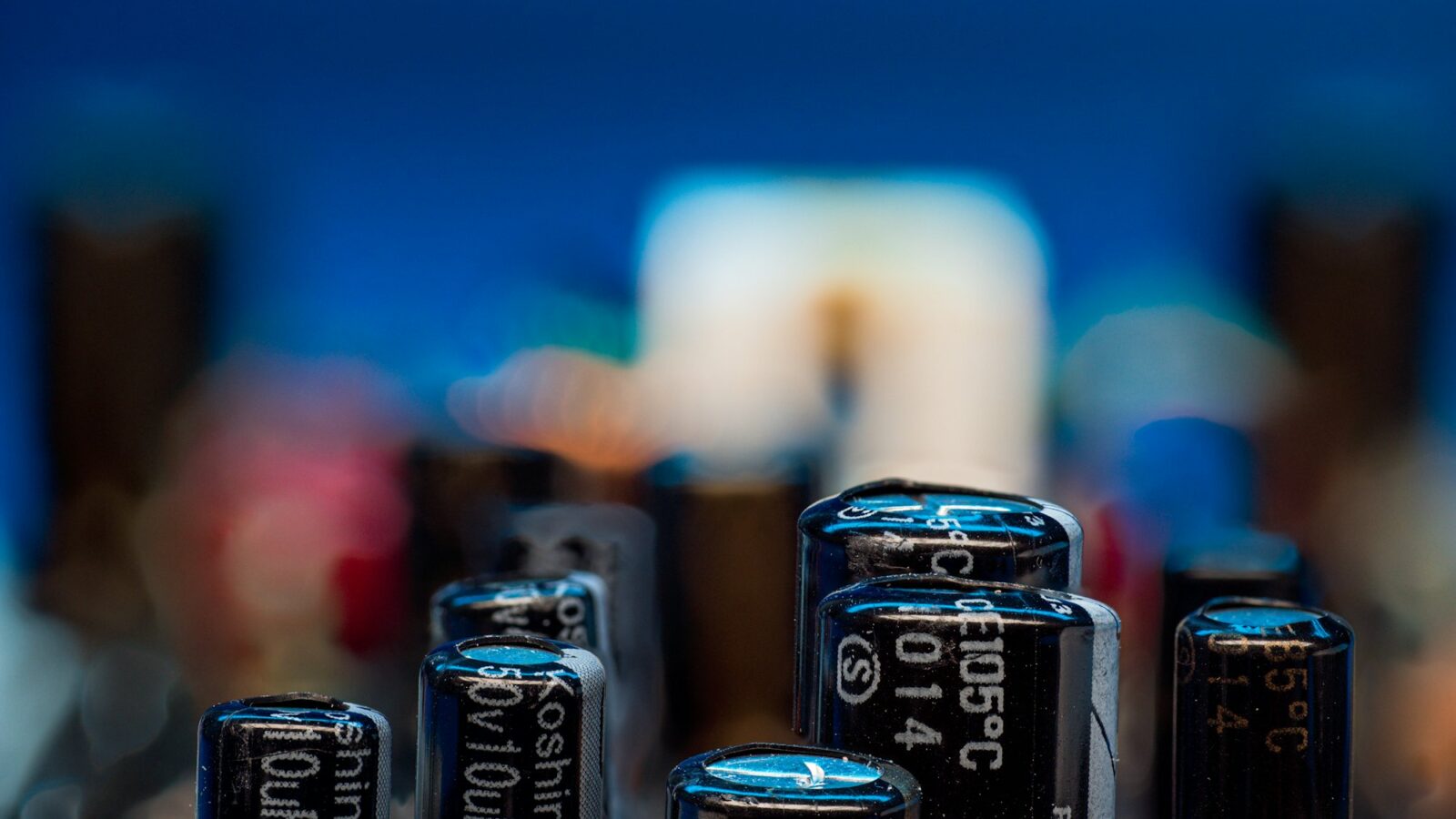
Pick up a phone and you are holding a crowd of capacitors, tiny parts that hold and release electric charge. Radios and satellites are full of them too. Each one takes up room, and room is the thing the people who design wireless devices never seem to have enough of. Every bit they get back is room for something else.
A paper published in Nature Electronics on October 6, 2026, hands back a little of it. An international team of materials scientists, most of them in China, used machine learning to hunt for a better dielectric (the insulating ceramic inside a capacitor), then made it and built working chip capacitors from it. One prototype, a 1-picofarad part measuring 0.35 by 0.35 by 0.20 millimeters, took up about 85 percent less volume than a comparable commercial part measuring 0.90 by 0.90 by 0.20.
Why is that hard? The materials face a stubborn tradeoff. A ceramic that stores a lot of charge tends to waste energy, or to drift as the temperature changes, and improving one property usually hurts the others. A part that drifts is a part engineers have to design around.
The machine learning did the searching. The team gathered property data from the published literature and crystal structure databases, including the Materials Project, a few hundred samples in all. They compared six common algorithms, kept a random forest to predict how much charge a material can store and support vector regression to predict how its capacitance shifts with temperature, and used those models to build and score a virtual library of 132,651 entries. From the flagged candidates, the team picked a tungsten bronze compound, citing its balanced predicted performance and ease of synthesis. The models also pointed at which atomic features mattered most, and that hint sent the chemists toward swapping bismuth and germanium into the crystal. I enjoy that division of labor: the software shrank an enormous haystack, and people chose where to dig.
What came out, Ba4(Nd0.5Bi0.5)9.33(Ti0.99Ge0.01)18O54, reached a dielectric constant of about 185 and a loss tangent of about 0.0005, with a temperature coefficient within plus or minus 30 parts per million per degree Celsius. In everyday terms, it holds a lot of charge, wastes very little and barely notices heat or cold.
The stress tests are what an engineer would ask about first. In accelerated lifetime testing at 1,000 volts and 150 degrees Celsius, capacitance changed by 0.1 percent or less over 100 hours, with no observed failures. After 1,000 thermal shock cycles between minus 55 and 150 degrees Celsius, the parts kept more than 99.8 percent of their capacitance. Using electron microscopy and quantum calculations, the team traced that toughness to strong germanium to oxygen bonds that hold the crystal’s internal charge displacements in place as it expands.
Now the honest distance. This is not inside any phone you can buy. The 85 percent compares one lab prototype with one commercial part, and the comparison is the authors’ own. These are single-layer chip capacitors, not mass-produced parts, and the paper gives no production timeline. Two of the co-authors are affiliated with a state key laboratory at Guangdong Fenghua Advanced Technology Holding Co. in Zhaoqing, China. Temperature-stable, low-loss capacitors are workhorses in radio frequency modules, integrated circuits and microwave communications, so if this ceramic can someday be made at scale, the people who build wireless gear would be the first to feel it.
The people who could benefit soonest are other scientists. The team set up an open-access dielectric database where others can share and upload data and train their own models. These models learned from only a few hundred samples because data for this kind of materials design is scarce. The next graduate student who sets out to find a better insulator could open that database and start with more than this team had.
Sources
Every claim in this story was checked against these sources on October 15, 2026. Spot something wrong? Tell us and the correction will be dated on this page.