Chest Scans People Already Get Could Help Catch Esophageal Cancer Earlier
The chest CT scans many people already get for other reasons could one day double as a check for early esophageal cancer. A model called EAGLE flagged cancer with 90.0 percent sensitivity at 98.5 percent specificity, validated across 12 centers in three countries; eight authors work for Alibaba.
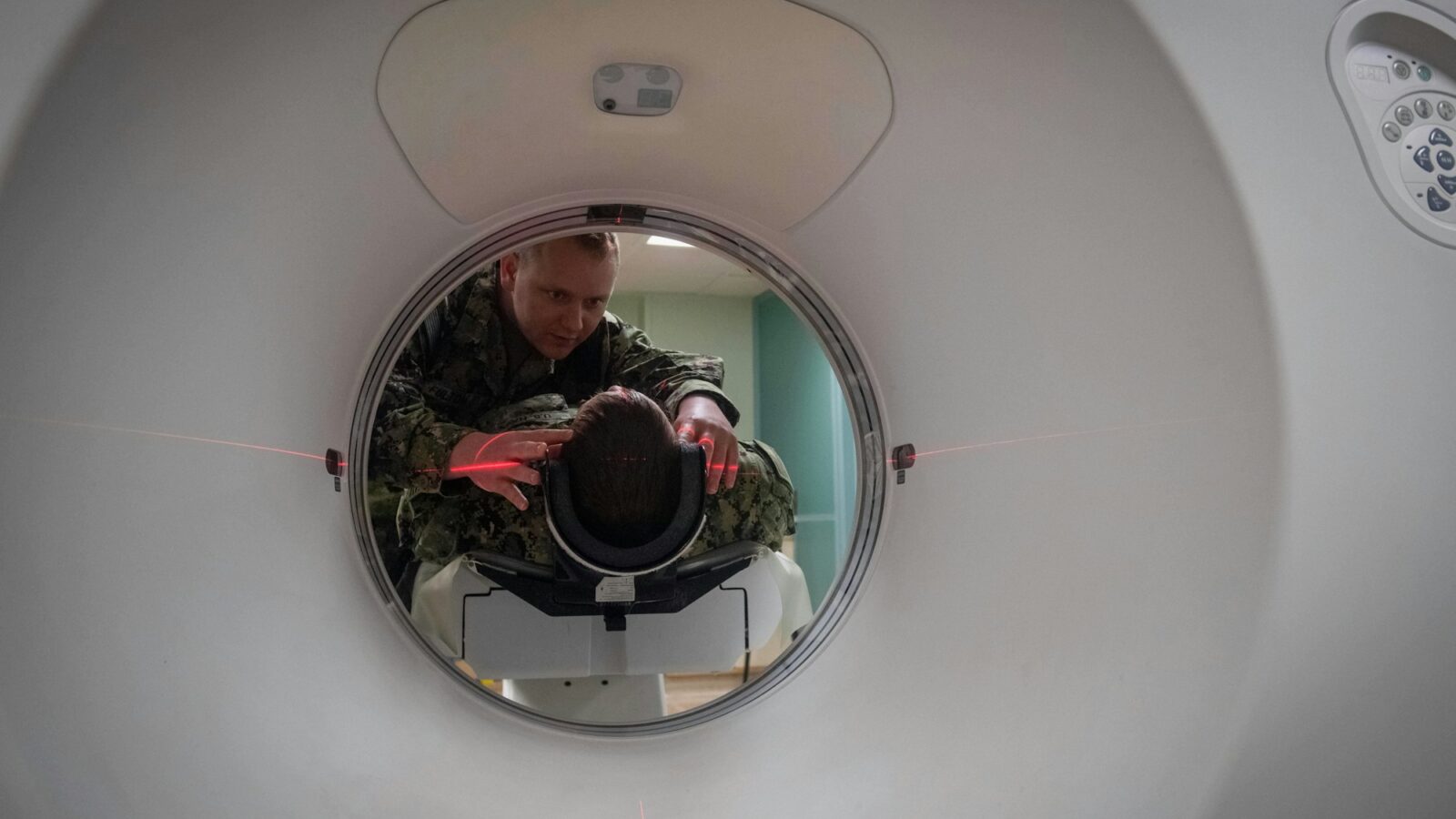
Picture someone lying on the table for a lung cancer screening scan. The machine images the lungs, but it also captures the esophagus, the tube that runs through the middle of the chest. Radiologists do not routinely scrutinize it for cancer on these scans. A new study suggests a computer model could.
That matters because esophageal cancer is usually found late. Five-year survival is 18.5 percent in the United States and 36.9 percent in China. Formalized screening programs are largely absent, and the standard screening test, endoscopy, means a tube down the throat, which is part of why compliance is low.
Researchers at Sun Yat-sen University Cancer Center, with colleagues at the DAMO Academy of Alibaba Group, Hupan Lab and hospitals in China, the Czech Republic and Australia, built a model called EAGLE (Esophageal AI-Guided malignant Lesion Evaluation). It first locates the esophagus in an ordinary noncontrast chest CT scan, then segments any lesions and predicts the probability of esophageal malignancy. The paper appeared in Nature Medicine on September 22, 2026. Eight of the authors are employees of Alibaba Group and own Alibaba stock, which the paper discloses, and the work was funded through a DAMO Academy (Hupan Laboratory) research program.
How well it did
EAGLE was trained on 6,813 patients from two centers, then validated across 12 centers in three countries covering 80,612 patients. On existing scans at eight external centers (11,466 patients), it reached 98.5 percent specificity, with 90.0 percent sensitivity for cancer and 52.5 percent for precancerous lesions. In a prospective hospital validation of 17,446 people, its positive predictive value was 42.2 percent. In real-world low-dose CT screening of 10,959 people, specificity was 99.94 percent, and recalibrating on a real-world cohort of 35,402 people at three centers cut false positives by 72.7 percent while preserving sensitivity. At a higher-sensitivity setting, in paired CT and endoscopy cohorts (702 patients), it reached 65.0 percent sensitivity for precancerous lesions and 78.4 percent for stage I cancer.
The paper calls the task one “historically considered impossible,” and you can see why. Early lesions can be confined to the lining of the esophagus, which is prone to collapse and to motion from the heart and great vessels. The authors also note a recent study finding that most people who died of esophageal cancer had no suspicious esophageal finding documented in their chest noncontrast CT reports in the preceding five years. The organ was in the picture the whole time.
The team tested the model alongside people, too. In two rounds of reader studies, 17 radiologists read 300 scans from four centers, with a washout period of at least three months between rounds, and the authors report that EAGLE significantly improved the radiologists’ ability to identify early cancers while lowering their false-positive rate.
What it could change, and what has to happen first
The hopeful version is simple. Validation on low-dose CT at two centers (1,607 patients) showed comparable performance, which the authors say supports esophageal cancer screening through existing lung cancer screening programs. For the person on that table, that would mean no new test, no new appointment, and an endoscopy only if the scan gives a reason. The study was registered in the Chinese Clinical Trial Registry (ChiCTR2300074806).
The honest version comes with conditions. Nothing in this paper shows that using EAGLE saves lives, and at its high-specificity setting it caught about half of precancerous lesions. The authors point to the fecal immunochemical test in colorectal cancer screening, which they note achieves meaningful population-level mortality reduction despite only moderate sensitivity for early-stage disease. An imperfect, easy test like that moves survival only when every person it flags has a clear road to an endoscopy and treatment.
So the next real step is not a cleverer model. It is a clinic ready to tell someone whose lung scan raised a question about their esophagus: here is your appointment, and here is what happens next. If that road gets built and studied, a scan a person was already getting could become the reason their cancer is found early.
Sources
- Large-scale esophageal cancer screening through noncontrast computed tomography and artificial intelligence
- Nature Medicine, DOI record
Every claim in this story was checked against these sources on October 15, 2026. Spot something wrong? Tell us and the correction will be dated on this page.