One Camera, No GPS: A Drone That Beat Human Champions Points to Simpler Robots
Fast robots that get by on a single camera and no GPS could one day be cheaper to build. A TU Delft drone that beat three world champion pilots in 2025 is now described in Science Robotics.
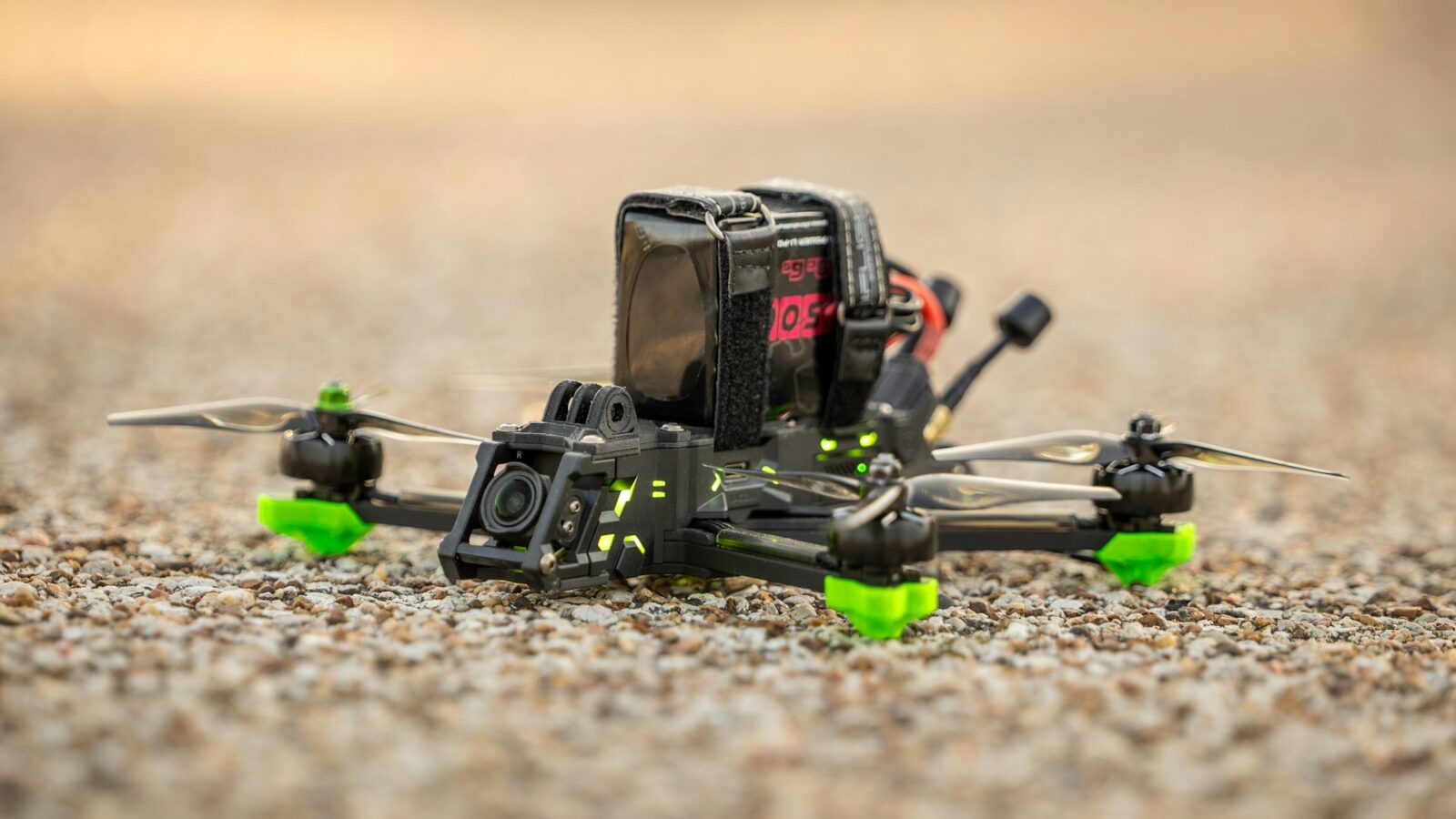
Fast robots usually lean on something outside themselves: GPS satellites overhead, motion-capture cameras bolted to a lab ceiling, a heavy computer riding along on board. Take the props away and most of them stumble. A team at Delft University of Technology in the Netherlands set out to find how little a flying robot really needs, and then tested the answer in about the least forgiving place available, a drone race against people.
Their system, MonoRace, flies on one forward-facing camera and an inertial sensor that feels acceleration and rotation. No GPS. No outside tracking cameras. In 2025 it won the Abu Dhabi Autonomous Drone Racing Competition, beating every other autonomous team and three world champion human pilots in a knockout tournament, at speeds up to 100 kilometers per hour. The science behind that win was published on October 14, 2026 in Science Robotics.
Two small networks doing the hard part
The first job is knowing where you are. A neural network looks at each camera frame and picks out the racing gates, and the system combines that with a physical model of the drone to estimate its position and motion. Which is harder than it sounds, as lead author Stavrow Bahnam explained in the university’s announcement, published by Tech Xplore:
“Flying at very high speed with only one camera is challenging because the images are blurry, deformed” Stavrow Bahnam, Delft University of Technology, via Tech Xplore
The second job is flying. In place of the usual stack of controllers, a second small neural network sends commands straight to the motors. According to the team’s preprint, it was trained with reinforcement learning, by trial and error in a simplified simulation of the drone whose physical settings were deliberately varied. The paper says it runs on the drone’s own flight controller 500 times a second, and that the system coped with real competition troubles such as camera interference and an overloaded motion sensor.
There is a pleasing honesty to the test itself. The earlier landmark, according to the paper, was a system with a stereo camera that beat human champions in a controlled indoor setting. This time, according to TU Delft, the drone and the race environment were designed and run by the competition organizers rather than the Delft team, so the robot had to handle a world it did not build.
Why a race matters to people who never watch one
Nobody needs a faster racing drone. What people do need, as robots move into homes, warehouses and ports, are machines that can make quick, safe decisions on cheap sensors and small processors, and keep working when GPS is not available. That is the skill the race was really testing.
The researchers say as much. Christophe De Wagter said the team wanted to find out “how much intelligence we could extract from very limited resources.” Professor Guido de Croon said the same approach, tuned for efficiency or safety instead of speed, could give smooth, “energy-optimal control on systems ranging from small vacuum-cleaning robots to huge ship-to-shore cranes.”
That is a hope, not a result, and the paper does not dress it up as one. Every number here comes from racing, on a known track with known gates, and the method is not tested anywhere else. The lesson travels, though: a robot does not always need more hardware to be capable. Sometimes it needs better learning on the little it already has. If that holds up away from the race course, the payoff is robots cheap enough to build and put to work in more of the places people live.
Sources
- MonoRace: Robust monocular AI for champion-level drone racing
- MonoRace: Winning Champion-Level Drone Racing with Robust Monocular AI (preprint)
- AI drone outpaces former world champions using one camera and no GPS
Every claim in this story was checked against these sources on October 18, 2026. Spot something wrong? Tell us and the correction will be dated on this page.