AI-Sharpened Scans Meant Fewer Needle Passes and Collapsed Lungs in Lung Biopsies
People who need a needle biopsy of a lung spot had fewer needle passes and fewer collapsed lungs when software sharpened the scans guiding the needle. Researchers in Wuhan, China, report the randomized trial in npj Digital Medicine.
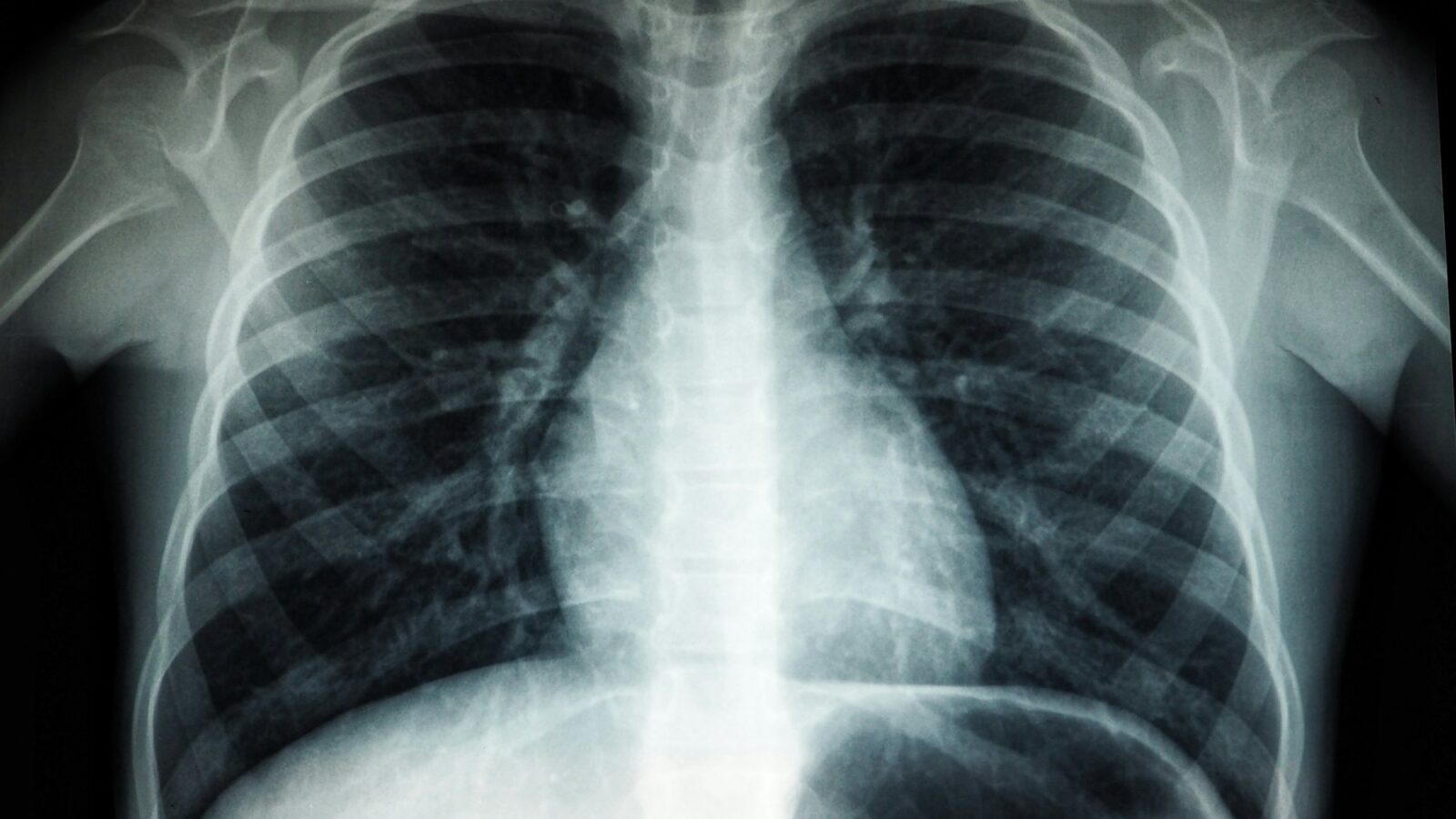
Finding a spot on a lung scan is frightening. Finding out what it is often means a needle biopsy: a doctor guides a thin needle through the chest wall into the spot to take a sample. Every extra pass of that needle is another chance for air to leak around the lung, which can partly collapse it, a complication called pneumothorax.
In a randomized trial in Wuhan, China, patients whose biopsies were guided with help from a generative AI system needed fewer needle passes, had shorter procedures, got less radiation, and had about half as many pneumothoraxes as patients guided the usual way. The results were published October 21 in npj Digital Medicine by a team from Union Hospital at Huazhong University of Science and Technology, Wuhan University and collaborators.
The trouble with the guiding picture
Many of these biopsies are steered with cone beam CT, a quick scan taken in the procedure room that shows where the needle is. It is convenient, but the pictures are grainy. The researchers note in the paper that poor image quality and limited guidance software make the procedure less efficient, especially for small or awkwardly placed nodules.
Their fix, called GPS-Lung, uses generative deep learning to turn those grainy scans into synthetic CT images, the kind of clearer picture a full CT scanner would give, and builds a needle guidance system on top. According to the trial protocol, earlier studies had used generative models to clean up these scans, but none had tested the idea in a prospective clinical trial.
What the trial found
Patients scheduled for a biopsy were randomly assigned to have it guided by GPS-Lung or by standard cone beam CT. According to the trial registry, 220 people enrolled between January and March 2025 at three campuses of Wuhan Union Hospital; the paper’s supplement reports results for 219, 110 guided by GPS-Lung and 109 the standard way. Compared with the standard approach, the AI-guided group had, on average:
- Fewer needle punctures: 2.0 versus 2.5.
- Shorter procedures: 20.4 minutes versus 23.2.
- Less radiation: 4,357 versus 5,571 units of dose (microgray square meters).
- Fewer pneumothoraxes: 12.7 percent versus 23.9 percent.
The study protocol posted to the registry says patients, data collectors and outcome assessors were not told which group a patient was in. The doctors doing the biopsies, of course, could see which guidance they were using.
Why half a needle pass matters
Half a puncture on average sounds small. For the person on the table, it is the difference between one fewer jab and one more, and the complication numbers show it adds up. A pneumothorax can mean more monitoring, sometimes a chest tube, sometimes a longer hospital stay. Cutting the rate from roughly one patient in four to about one in eight would matter to every one of them, and less radiation helps both the patient and the staff who do these procedures all day.
The idea is also quietly practical. The hospital does not swap out its scanner. The improvement comes from software applied to the pictures the existing scanner already takes, which is the kind of change that could travel to other hospitals if it holds up.
A note on interests: according to the paper, four authors, all listed at Neusoft Medical Systems, an imaging equipment maker, have a financial interest in the company, and the statement adds that they did not support the work. The study was funded by the National Natural Science Foundation of China and Hubei provincial programs, and the authors also thank Xiaomi and Kingsoft for their support.
The next person told that a lung spot needs sampling is not going to be offered this system yet. But the trial suggests a future biopsy could be a little shorter, a little gentler and a little safer, with the help of a clearer picture.
Sources
- A Generative AI-powered navigation system for precision CBCT-guided lung biopsies: a randomized controlled trial
- Enhancing CBCT-Guided Lung Nodule Puncture Efficiency With Generative AI (NCT06762613)
- Study protocol: Generative AI-Powered Navigation System for Precision Puncture: A Multicenter Randomized Controlled Trial Evaluating Efficacy and Safety (V2.0)
- Supplementary Materials: A Generative AI-Powered Navigation System for Precision CBCT-guided Lung Biopsies
Every claim in this story was checked against these sources on October 25, 2026. Spot something wrong? Tell us and the correction will be dated on this page.