Anyone Can Now Watch 27 Years of a Black Hole Jet, Thanks to AI
Anyone can now watch a black hole's jet move across 27 years, in a video built from real radio telescope data. A Nature study from IAA-CSIC, Caltech and Toronto used a neural network to make it.
One hundred sixteen pictures, taken over 27 years, of a jet of matter flung from a supermassive black hole in a faraway galaxy. Until this summer they were mostly separate snapshots. Now they are a movie.
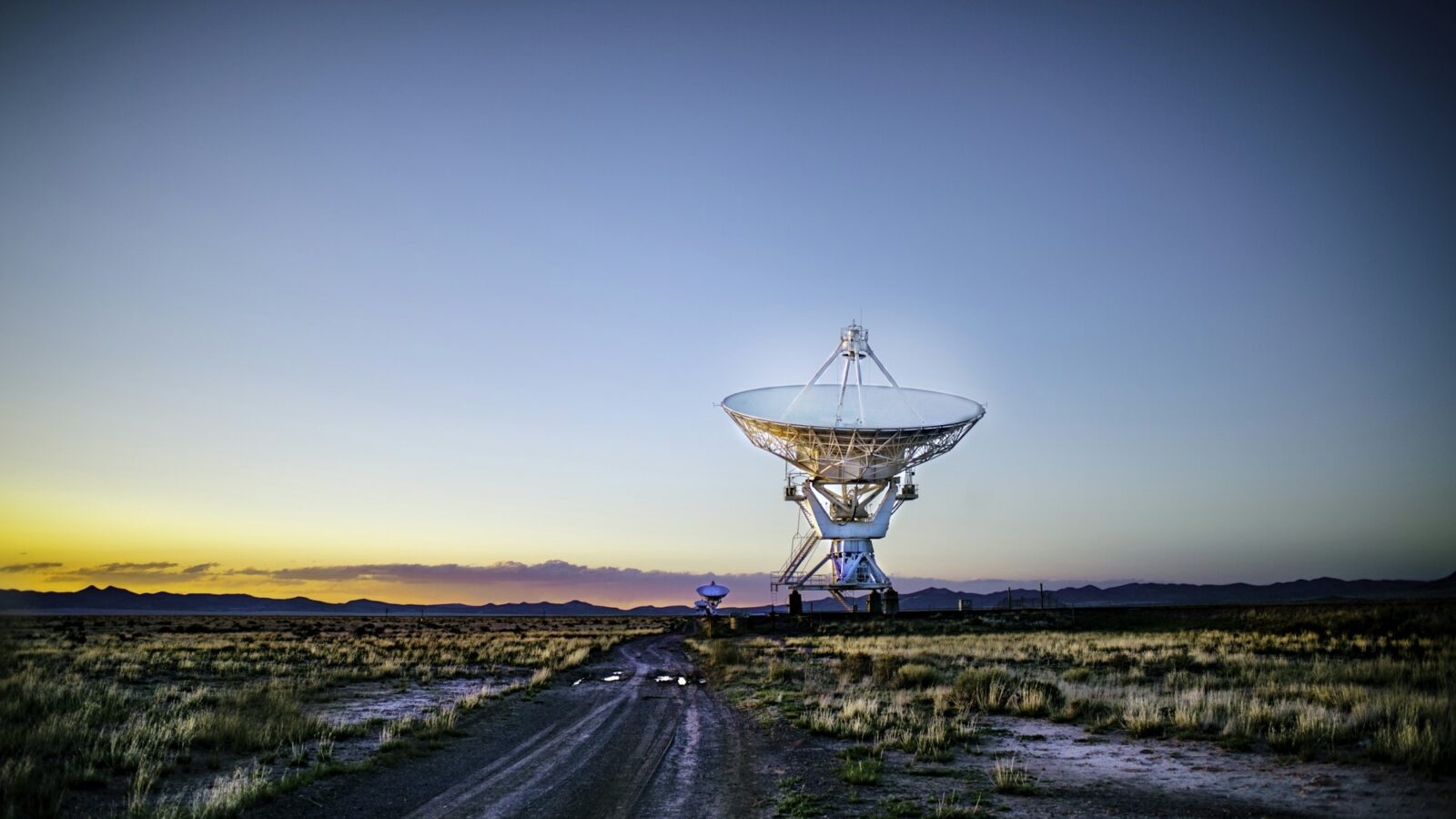
In a paper published August 26, 2026 in Nature, astronomers at the Instituto de Astrofísica de Andalucía (IAA-CSIC) in Granada, Caltech and the University of Toronto describe kine, a method that turns scattered radio telescope observations into a continuous, high resolution video. They used it on 3C 345, a blazar, which is a feeding black hole whose jet points nearly at us (the paper puts the angle at 3 to 6.8 degrees from our line of sight). The observations came from the Very Long Baseline Array, a network of radio dishes, through the MOJAVE monitoring program, between 1995 and 2022.
The trick that makes the movie
A radio array like this one samples the sky only sparsely, so each night’s image is blurry and incomplete. The usual approach cleans up each observation on its own. Kine instead uses a neural network as a compact description of the whole video, then fits all 116 observations at once. As the team wrote, it processes “observations at different times, while learning and leveraging the spatio-temporal correlations present in the data.” Each frame borrows information from its neighbors in time.
The numbers are striking. The paper reports a resolution of about 113 microarcseconds, a fourfold gain over the nominal value, and a dynamic range (the span between the faintest and brightest features it can show) about 140 times greater than traditional methods. Because the video is continuous, the team could treat it like ordinary footage and measure how fast every patch of the jet moves, not just the bright blobs.
What the movie showed
Here is where it gets fun. On the sky, the bright blobs in the jet appear to race along at 10 to 13 times the speed of light, while the surrounding plasma moves at 9 to 12 times. Nothing is breaking physics: these “superluminal” speeds are an illusion created by matter moving almost straight toward us at nearly light speed. The paper says the fastest average flow corresponds to a true speed of 0.997 times the speed of light.
The surprise is that the blobs and the flow move at about the same speed. Many astronomers have read those blobs as shock waves, which should outrun the plasma around them. The polarization data did not show the pattern shocks would leave either. The team instead interprets the blobs as regions of locally amplified magnetic field glowing more brightly.
“Our work does not invalidate the shock model in general, but it puts it into question, at least in the case of this specific source,” first author Marianna Foschi, a postdoctoral researcher at Caltech, told Live Science in an email.
Why a black hole movie is worth your time
Part of the answer is plain wonder. Anyone can watch a jet from a distant black hole wriggle across nearly three decades, in a video built from real measurements rather than an artist’s impression.
Part of it is practical. The authors say kine was first built for the Event Horizon Telescope’s observations of Sagittarius A*, the black hole at the center of our galaxy, which changes too fast for a single still image. They also point out that MRI reconstruction is formally the same kind of problem, and that kine could prove useful for imaging moving organs. That is the authors’ suggestion, not something they tested, and no scanner uses kine today.
The next stop is closer to home for astronomers: hundreds of other jets already sit in the same monitoring archives, waiting to be turned into movies of their own.
Sources
- Video reconstruction of variable VLBI observations with neural fields
- Plasma-jet movie is astronomy's summer blockbuster (News and Views)
- See the highest-resolution footage of a black hole jet ever taken, thanks to AI and 27 years of observations
Every claim in this story was checked against these sources on October 15, 2026. Spot something wrong? Tell us and the correction will be dated on this page.