Astronomers Gain 55 Natural Telescopes That Could Help Map the Invisible Universe
Fifty five confirmed cosmic lenses give scientists new ways to study dark matter and how fast the universe is expanding. A team led by Emerald Lin and Ivonne Toro Bertolla checked 76 neural network picks with telescope spectra, confirming 55; 15 more need further observation and six were not lenses.
Emerald Lin is an undergraduate at the University of California, Berkeley. Together with Ivonne Toro Bertolla, a research assistant at NSF NOIRLab, she led the work that has just handed astronomers 55 new instruments, and not one of them had to be built.
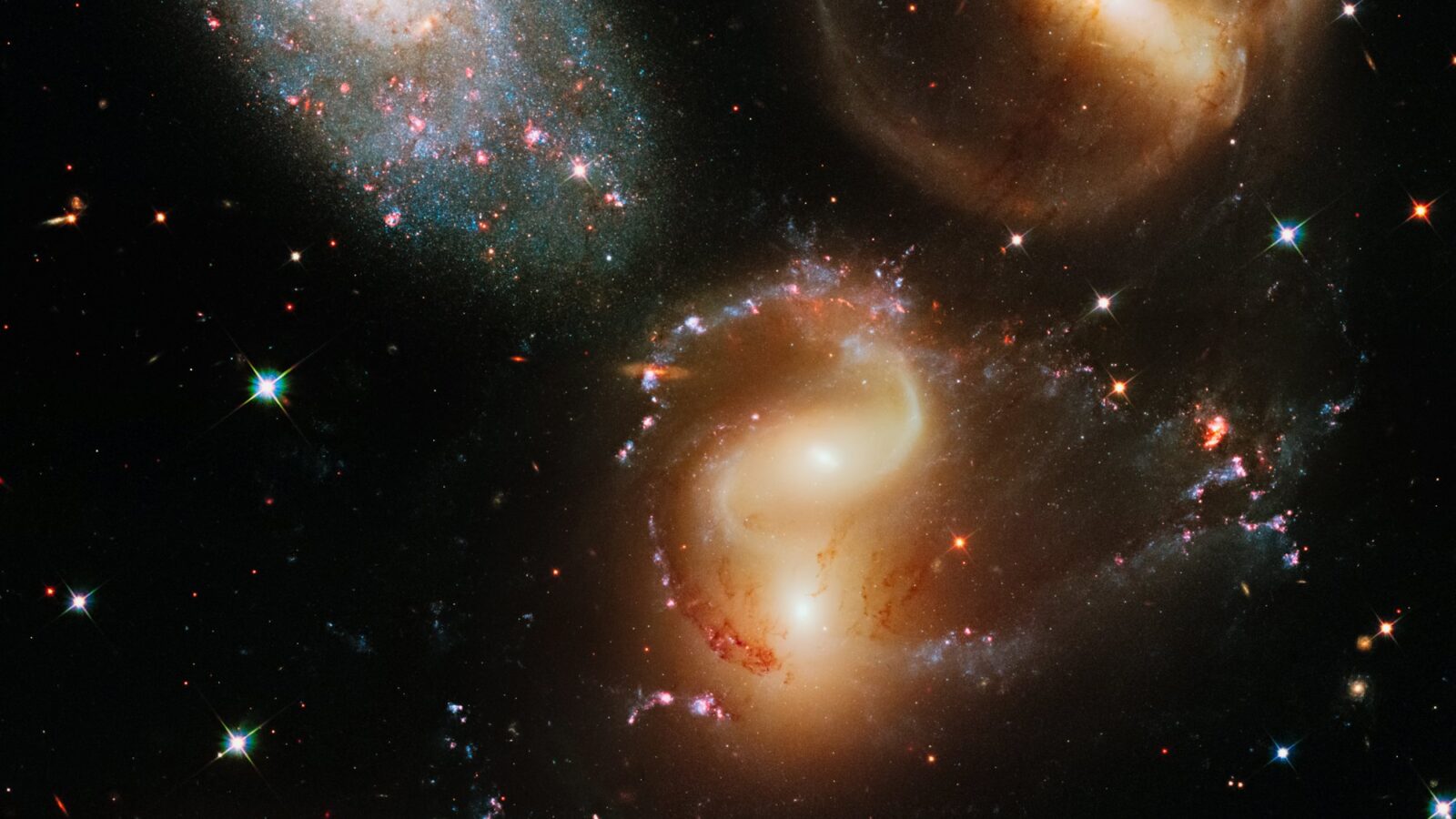
They are gravitational lenses. A massive galaxy sits between us and something much farther away, its gravity bends the distant light, and the far object appears smeared into arcs or rings. Each alignment works like a free telescope, which is the kind of gift astronomers do not turn down. According to NOIRLab, lenses can reveal how invisible dark matter is distributed and can help improve measurements of how fast the universe is expanding. Those are questions about the universe all of us live in, and every confirmed lens is one more place to test the answers.
The confirmations appear in a paper published online in The Astrophysical Journal Supplement Series on August 13, 2026, the fourth in the DESI Strong Lens Foundry series. The team took spectra of 76 candidates that a neural network had flagged and sorted them into three piles.
- 55 fully confirmed, with both a lens redshift and a source redshift measured.
- 15 still waiting, with a lens redshift only. The authors say these systems require additional observations for confirmation.
- 6 struck off, because they were not lenses at all.
If you read NSF NOIRLab’s announcement, you will see a count of 70 confirmations. The paper itself treats only the 55 as fully confirmed, and that is the number to trust until the other 15 get better data.
Lenses are rare, which is why a neural network was involved in the first place. Xiaosheng Huang, of Santa Clara University and the Department of Energy’s Lawrence Berkeley National Laboratory, led the network searches, which the paper cites from 2020 and 2021. A residual neural network, a type of image model built to pick out faint repeating patterns, was applied to the DESI Legacy Imaging Surveys using computing at the National Energy Research Scientific Computing Center, and it produced thousands of candidates.
The imaging behind those searches has since grown into what NOIRLab calls the largest two dimensional map of the universe, released in August 2026: 5.6 trillion pixels covering nearly 4 billion objects, assembled from the Dark Energy Camera on the Victor M. Blanco 4 meter telescope in Chile, the Nicholas U. Mayall 4 meter telescope at Kitt Peak, the University of Arizona Bok 2.3 meter telescope, and data from NASA’s WISE mission. No person is going to inspect 4 billion objects in a working lifetime. The network’s job was to shrink that haystack to a list short enough for people and a big telescope to get through.
The checking was done with the Multi Unit Spectroscopic Explorer, known as MUSE, on the European Southern Observatory’s Very Large Telescope, in observations spanning 2022 to 2024. Confirming a lens means showing that two objects at genuinely different distances are stacked along the same line of sight, so you need a redshift for the foreground lens and another for the background source. From 223 extracted spectra, the team measured both for 55 systems. The confirmed set includes some of the rarer and more informative cases: systems with multiple source planes, and lenses sitting in groups and clusters.
These are the ones cosmologists can actually use, and they are shared.
“Each confirmed lens adds to a resource that will benefit the entire astronomical community.”Aleksandar Cikota, associate scientist at NSF NOIRLab and principal investigator of the follow up observing program
That community includes people at the very start of their careers, which is part of what makes an undergraduate co-leading this paper worth saying out loud. It also now has a plain recipe for turning a machine’s guesses into science: a model proposed, a telescope checked, and the six wrong guesses went on the record right beside the hits. Thousands of candidates from the same searches are still waiting for telescope time. Whoever works through the next batch will know how much to trust the list before they start.
Sources
- DESI Strong Lens Foundry. IV. Spectroscopic Confirmation of DESI Lens Candidates with VLT/MUSE
- DESI Strong Lens Foundry IV (open access preprint)
- Largest 2D map of the universe helps scientists discover new gravitational lenses
Every claim in this story was checked against these sources on October 15, 2026. Spot something wrong? Tell us and the correction will be dated on this page.