Hidden Human Proteins Found by Shape Could One Day Become Drug Targets
Many proteins in our cells are still unexplored, and a search by shape just found some that could one day become drug targets. University of Miami scientists searched AlphaFold predictions and found TM184C, which helps build bridges between cells.
Most medicines work by latching onto a protein. So every protein we do not understand is, in a sense, a door nobody has tried. By one widely used count cited in a new paper, 5,516 of 20,412 human proteins (27 percent) sit in the darkest category, poorly characterized and with no approved drugs.
A team at the University of Miami Miller School of Medicine and its Sylvester Comprehensive Cancer Center went looking for doors in a new way. Reporting in Nature on September 9, 2026, they describe mining millions of AlphaFold2 protein structure predictions, searching by three dimensional shape instead of by genetic sequence. What turned up was a human protein called TM184C that looks like one of the most important drug target families in the body, yet behaves in ways no one expected.
The puzzle: proteins that look alike but do not spell alike
Biologists usually guess what a protein does by comparing its sequence with proteins already studied. That fails when two proteins have drifted so far apart over evolution that their sequences no longer match, even though they still fold into the same shape. Shape tends to outlast spelling.
The family the team had in mind is the G protein coupled receptors, or GPCRs. The paper notes that more than 800 human GPCRs regulate key processes in the body and are principal drug targets, yet more than 100 are still poorly understood.
How the AI helped
AlphaFold2, a deep learning model, predicted the 3D structures behind this search. The Miami team downloaded the public AlphaFold database (24 tebibytes compressed) and compared all 214,528,851 predicted structures in it against the shape of rhodopsin, a classic GPCR, using a standard structure comparison program called TM-align plus their own filters, hunting for the seven pass, membrane spanning fold of a GPCR. The AI’s part was the predictions themselves, made by AlphaFold2 and shared publicly; the shape search was conventional computing on a very large scale. The search flagged eight candidates; after setting aside two already proposed as GPCRs, six remained in two families, called TM184 and PRRT. The authors call them “superdark”: they resemble well known proteins in shape while sharing no clear sequence family resemblance.
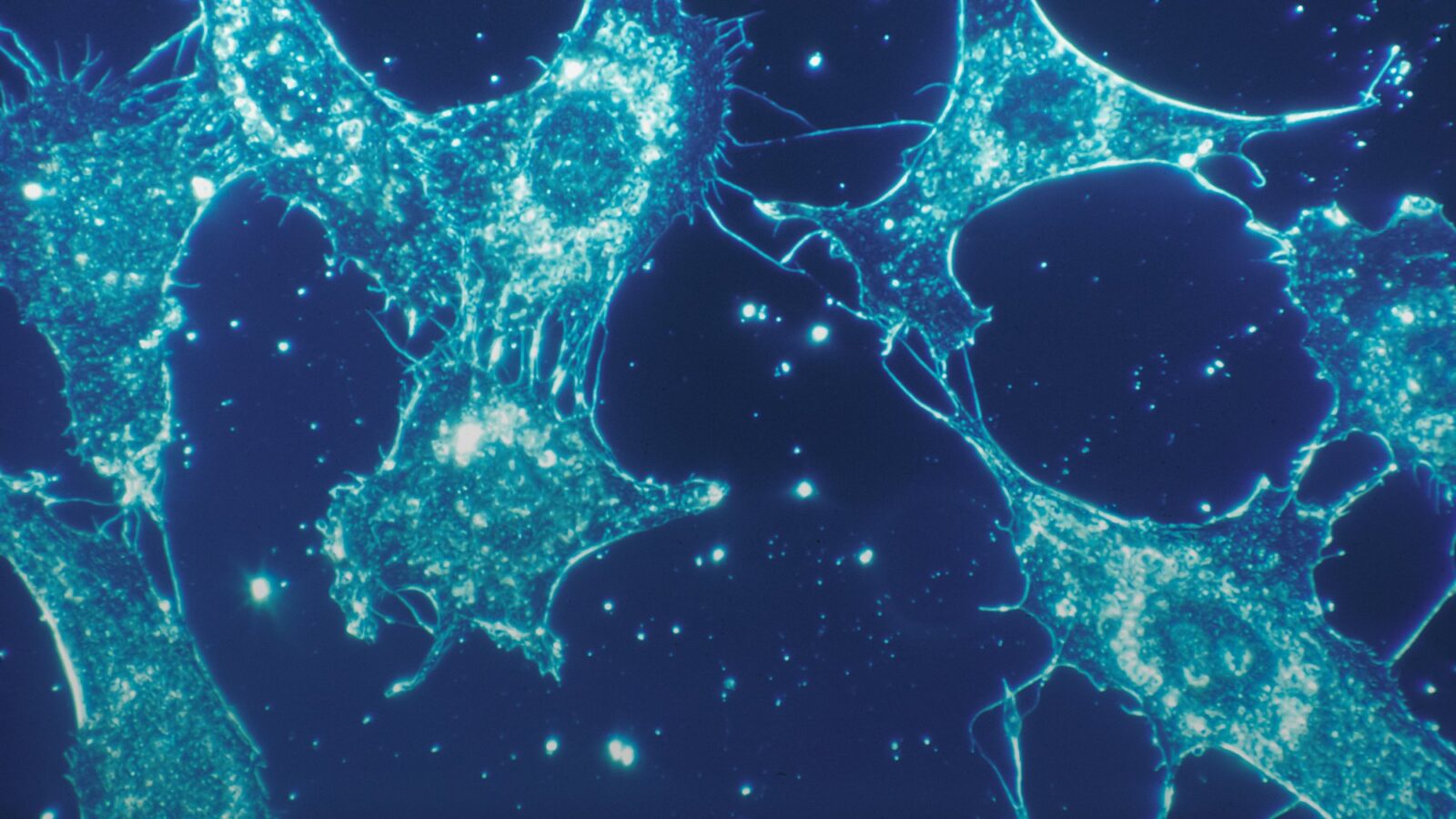
Then came the lab work, which is what makes this a discovery rather than a list. TM184C showed hallmark GPCR behaviors, recruiting the signaling partner beta-arrestin and being chemically tagged by GPCR kinases. But it lives mostly inside the cell, on small moving packages called vesicles that travel along the cell’s internal tracks and gather in thin projections. Those projections formed bridges between neighboring cells, and through them cells passed vesicles, lysosomes and even mitochondria, the cell’s power plants. When the team knocked TM184C down with CRISPR, cells rounded up and lost those projections and bridges.
Bridges carrying TM184C formed in several cell types the team tested, including fibroblasts, brain support cells called astrocytes, patient derived glioblastoma cells and melanoma cells. TM184C also helps tune autophagy, the cell’s recycling system. Human TM184C restored normal recycling in yeast missing their own version of the protein, called Hfl1. The university says that shared function has held up across about a billion years of evolution.
“AI cannot be blindly trusted, but can lead to really big things in the hands of experts and prepared minds.” Daniel G. Isom, senior author, University of Miami Miller School of Medicine
Who this could help, someday
Nobody is getting a TM184C drug. There is no known molecule that switches it on, and everything so far happened in cells in a dish and in yeast. But the authors argue that their approach, structure mining first and careful experiments second, should help identify new therapeutic targets well beyond this one protein. And the cell bridges themselves raise real questions for cancer. According to the university, a graduate student in the lab, Bruno Colon, is now studying these connections in normal cells and in glioblastoma, an aggressive brain cancer, hoping to learn how such tumors communicate. That is early, ongoing work; nothing has been tested in animals or patients.
For the people who live with diseases that today’s drug targets cannot reach, the hopeful part is simple: there are proteins in our own cells nobody had properly looked at, and now there is a way to find them by shape.
Sources
- TM184C is a GPCR-like regulator of intercellular exchange and autophagy
- TM184C is a GPCR-like regulator of intercellular exchange and autophagy (open access full text)
- AI Helps Find Hidden Human Proteins and Reveals What They Do
- 'Superdark' protein looks like a G-protein-coupled receptor, but shows unconventional behaviour (News and Views)
Every claim in this story was checked against these sources on October 15, 2026. Spot something wrong? Tell us and the correction will be dated on this page.