A Step Toward Rebuilding the Microbe Factories That Make Some Antibiotics and Cancer Drugs
The microbe assembly lines behind some antibiotics and cancer drugs could one day be rebuilt with parts made to order rather than scavenged from nature. A team at the Helmholtz Institute for Pharmaceutical Research Saarland designed 76 carrier parts with generative models, and the best raised output of a model peptide by up to about three times.
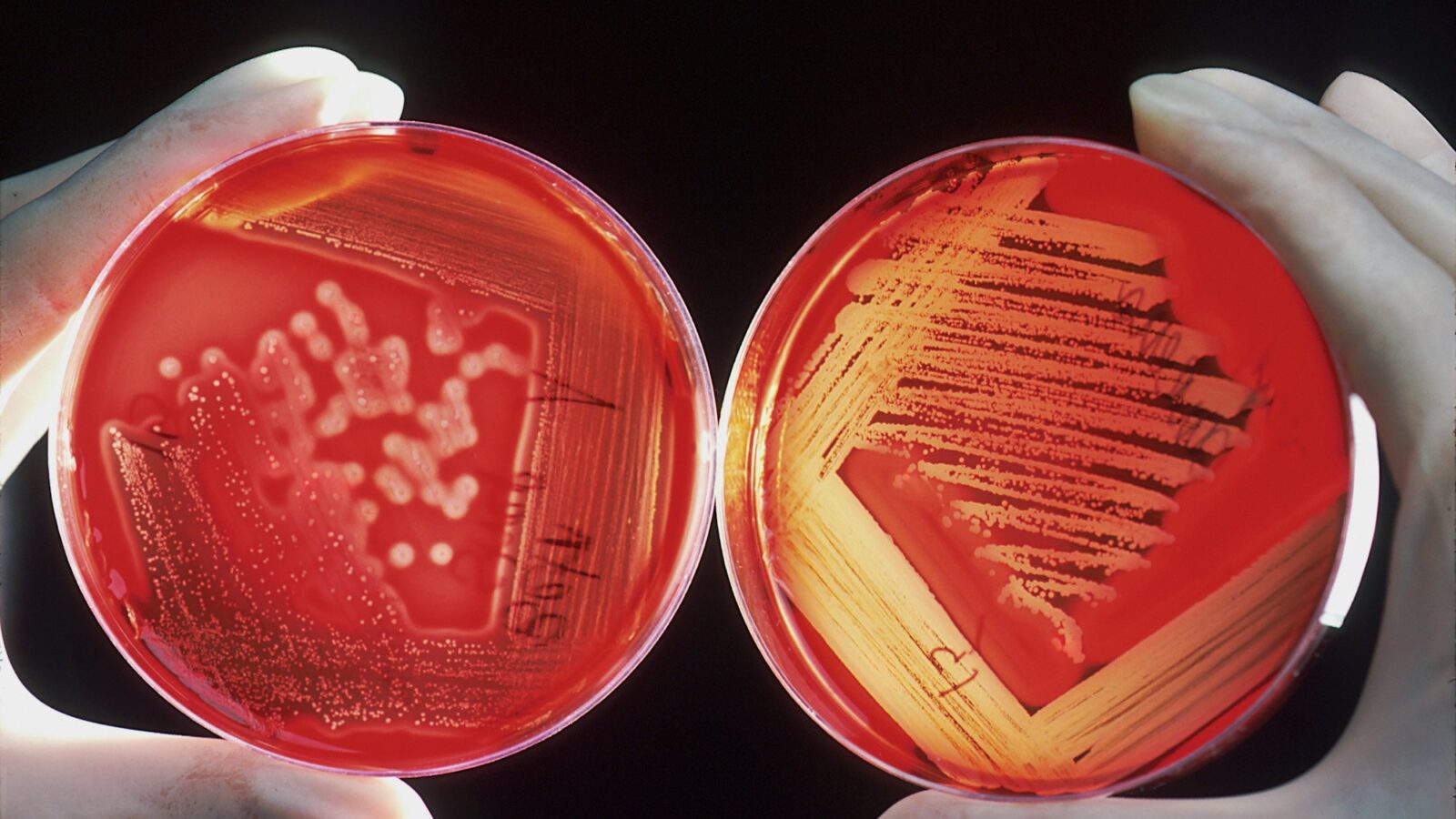
Some of the medicines people count on were never put together by chemists. They were assembled by microbes, on enzyme production lines called non ribosomal peptide synthetases, which hand a growing chemical chain from station to station. Clinically important antibiotics, immunosuppressants and anticancer agents come off lines like these. For anyone who has needed a drug in one of those families, and for the scientists who want to make new ones, rearranging the stations to make something different has been the goal for years. It keeps failing at the joints.
A team at the Helmholtz Institute for Pharmaceutical Research Saarland decided to stop scavenging joints from nature and design them instead. In a paper published in Nature Communications on September 22, 2026, they report 76 new carrier parts, not one of them borrowed from a natural enzyme, proposed by generative protein models, then built into 578 rebuilt assembly lines and tested in living E. coli. The best designs raised yields of a model peptide by up to about three times. No medicine was made here, and nothing was tested against bacteria.
Before: hoping nature had left a spare part
The fussy piece is the thiolation domain, the small carrier that holds the growing chain and passes it along. Swap one in from a different enzyme and the whole line often stops. So anyone who wanted to rewire one of these factories had to hope a compatible natural connector was lying around somewhere, which is how a field full of good chemists spent years stuck on what amounts to plumbing.
After: parts written for the job
The models wrote sequences no organism has. Three generative systems produced the candidates: the protein language model ESM3, the diffusion model EvoDiff and the inverse folding model ProteinMPNN. ESM2 filtered them by perplexity, ESMFold checked the predicted structures, and ESMC was used as a surrogate model to rank what was worth building next. The team ran this as design, build, test and learn cycles, so each round of bench results shaped the next, and a prescreen worked through 66 of the domains in three rounds of 11, 25 and 30.
Then the numbers. In the full length GxpS system making cyclo(vLflL), the model peptide the team used as its readout, the design called AI-27 reached about 257 percent of wild type output, roughly 7.4 milligrams per liter. In a hybrid line, AI-12 lifted product peak areas by around 65 percent over the native part. And one design was simply a sturdier protein: AI-2 melted at about 52 degrees Celsius, against about 40 for the refolded natural domain, and it expressed and refolded more readily.
What they could not predict
Which designs would work. The authors report that mean pLDDT, the structure confidence score everyone leans on, showed no significant correlation with how much product a design made. The models were good at proposing parts that fold and still pass their cargo along inside a cell, and no help at guessing which of those parts a bacterium would like. The only way to find out was to build all of them, which is a humbling and rather cheerful result.
Who this could reach, and how far off it is
Not patients, not yet, and the authors are careful about how far their parts travel. Nothing here is a new drug, and nobody has shown that any of this kills bacteria.
What has changed is the starting position for the next person who wants to rewire one of these lines. They no longer have to hope nature left a compatible connector behind. If designed connectors keep working, the people who could eventually benefit are the ones waiting on medicines that are hard to make. There is a nearer beneficiary too: a part that survives a warmer tank and expresses cleanly is worth something to the people running fermenters, who tend to notice that before the chemists do. That is the honest size of it. A plumbing problem that has blocked a useful field for years has a new approach, and the first real test is whether these parts behave as well in assembly lines further from the ones they were designed for.
Sources
- Generative AI designs functional thiolation domains for reprogramming non-ribosomal peptide synthetases
- Nature Communications article record (DOI 10.1038/s41467-026-77963-6)
- Generative AI designs functional thiolation domains for reprogramming non-ribosomal peptide synthetases (preprint)
Every claim in this story was checked against these sources on October 15, 2026. Spot something wrong? Tell us and the correction will be dated on this page.