Before We Trust Quantum Answers, Someone Has to Check Them. This Summer Someone Did
If quantum computers are ever going to be trusted with answers people rely on, claims about them have to survive outside scrutiny. IBM's quantum advantage preprint got it: 256 GPUs computed the exact odds of every output it published, and IBM then redesigned the test with the challengers as coauthors.
One day, if this works out, a quantum computer will hand someone an answer that matters: a molecule worth testing, a material worth making. What decides whether anybody can act on it is not how impressive the machine is. It is whether an outsider can check the claim. This summer that process ran through a complete turn in public.
In short: an IBM Research and University of Chicago team posted a quantum advantage experiment that came with its own certificate of accuracy. Researchers at the Singapore University of Technology and Design and NVIDIA checked it on 256 GPUs, found a weak spot in the circuit’s design, and found the accuracy estimate held up. IBM rebuilt the experiment, and the challengers are now coauthors.
July 28: a claim that came with a receipt
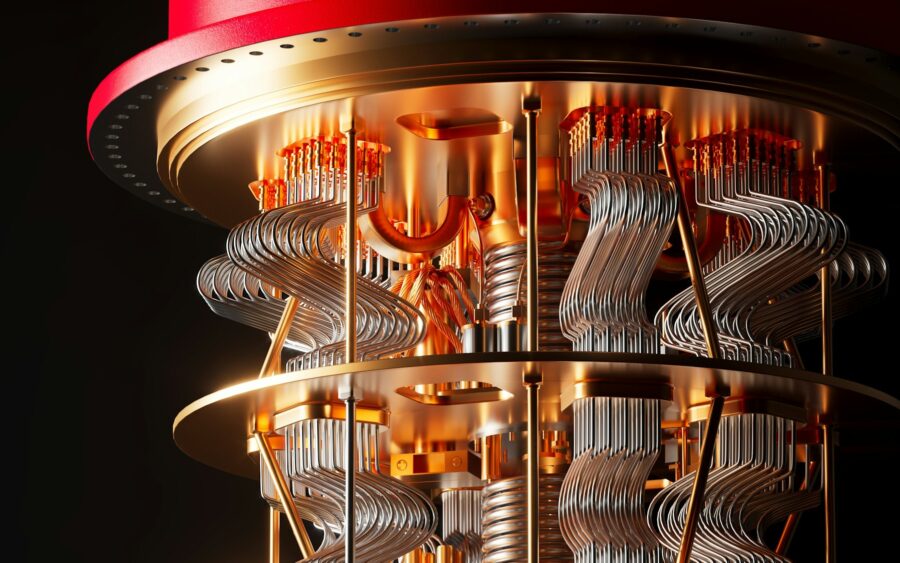
The team posted the preprint “Sampling hard circuits with verifiably high fidelity”, and IBM presented it on its quantum blog as one of three quantum advantage demonstrations. It ran a 70-qubit circuit with depth 70 and 468 T gates, the ingredient that makes circuits hard for classical computers, encoded with error detection on 97 physical qubits.
The clever part was the receipt. By checking the error detection signals, the team cut effective gate errors about 10-fold and certified a lower bound on the run’s accuracy: fidelity of at least 0.284, with 95 percent confidence. The authors write that it has been difficult to combine the classical hardness of these tasks with a way to verify the quantum computation itself. Here the processor produced its own evidence of quality, which does not depend on a classical computer reproducing the answer. For a field whose results most people can never check themselves, that is the interesting move.
August 13: the challengers do the math
Hidetaka Manabe and Feng Pan of the Singapore University of Technology and Design and Hanfeng Gu of NVIDIA posted a classical simulation of that exact experiment. On 256 NVIDIA H100 GPUs (32 nodes of eight) they computed amplitudes for all 2,051 batches corresponding to the output bitstrings IBM had published, in 37.3 minutes. To be precise: they did not rerun or sample the experiment. They computed the ideal probabilities for samples IBM had already released.
Their largest intermediate data structure was 256 times smaller than IBM had estimated. The weak spot was the circuit’s shape, a one-dimensional chain with open ends, which allowed an efficient path through the calculation whose cost depended on depth rather than on how many T gates were added.
And yet the attack also backed IBM up. From their probabilities the challengers estimated the run’s quality and found it, in their words, “numerically compatible with IBM’s fidelity lower bound,” under standard statistical assumptions they spell out. The receipt was honest.
September 1 and 2: a harder test, with new coauthors
IBM’s revised versions list Manabe, Gu and Pan as coauthors. The new run is a 64-qubit, depth 73 circuit with 314 T gates on 76 physical qubits, with a fidelity lower bound of 0.349. A note added to the paper says the design uses periodic boundary conditions, “eliminating the low-width contraction path exploited before,” and credits the earlier simulation, about 159 H100 GPU-hours, with independently verifying the fidelity estimate.
The revised paper reports about 1,400 samples in 14 minutes and estimates that this instance is infeasible for current tensor-network and stabilizer-based classical algorithms. The authors acknowledge, to their credit, that the time to simulate it may change as methods improve.
Why a benchmark fight is good news
Nothing here is useful yet. Sampling from specially designed circuits is a benchmark, not a calculation anyone needed, and both papers are preprints that have not been peer reviewed. What the episode shows is a field correcting itself in weeks rather than years, with the people who poked the hole invited onto the paper. That habit is what would let a doctor, an engineer or a regulator eventually take a quantum result seriously, because somebody outside the company that built the machine will have checked it.
For now the open question has a specific address: is there an efficient classical path through a chain whose ends have been joined into a loop?
Sources
- Sampling hard circuits with verifiably high fidelity (preprint, v1 and revised v3)
- Classical Simulation and Design Frontiers for IBM's Doped Clifford Sampling Experiment (preprint)
- Researchers demonstrate quantum advantage through trusted quantum computation
Every claim in this story was checked against these sources on October 15, 2026. Spot something wrong? Tell us and the correction will be dated on this page.